How Many Calories Should My Dog Eat? A Simple Guide for Dog Owners
In this guide, we’ll answer the most common questions about your dog’s calorie needs and help you understand how many calories your dog may need each day.
If you have ever looked at your dog’s food bowl and wondered, “Am I feeding too much or too little?”, you are not alone. Feeding instructions are useful, but they cannot tell you exactly how many calories your individual dog needs.
A quiet adult dog may need much less energy than an equally sized dog that runs or trains every day. Puppies, seniors, overweight dogs, and working dogs can also have different needs.
In this guide, we’ll explain how dog calorie needs are estimated, show you a simple example, and explain how to turn calories into actual food portions.
How Many Calories Should My Dog Eat Per Day?
The honest answer is that it depends on your dog’s weight, age, activity level, body condition, neuter status, and overall health. That’s why there isn’t one calorie number that works for every dog.
If you have ever wondered, “How many calories should my dog eat?” the answer depends on more than just your dog’s weight.
One common way to estimate a dog’s calorie needs is to start with something called Resting Energy Requirement (RER). In simple terms, RER is the approximate number of calories your dog needs just to support basic body functions while resting.
The formula looks like this:
RER = 70 × (body weight in kg)^0.75
Don’t worry if the formula looks complicated. You don’t need to calculate it yourself.
You can use our Dog Calorie Calculator to calculate your dog’s estimated daily calorie needs in just a few steps.

Let’s Understand This With an Example
For example, a 10 kg dog has a resting energy requirement (RER) of about 394 calories per day.
But your dog needs energy for more than just resting. Walking, playing, and normal daily activities all require extra calories. This is where Maintenance Energy Requirement (MER) comes in.
For a healthy neutered adult dog, a commonly used starting point is 1.6 × RER:
394 × 1.6 = about 630 calories per day
So, around 630 calories per day may be a reasonable starting estimate for this example.
Keep in mind that every dog is different. Two dogs of the same weight may need different amounts depending on their activity, body condition, and daily routine.

What Changes a Dog’s Calorie Needs?
Your dog’s weight is a helpful starting point, but it doesn’t tell the whole story. Age, activity, body condition, and lifestyle can all affect how many calories your dog needs.
Age
Puppies are growing, so they generally need more energy relative to their size than adult dogs. Their requirements also change as they grow.
Adult dogs usually need enough energy to maintain their body weight and condition. Older dogs may become less active, although not every senior dog needs fewer calories.
Activity Level
Think about what your dog actually does during the day.
A dog that takes two short walks and spends the rest of the day resting may need less energy than a dog that runs, hikes, swims, trains, or works for several hours.
Even two dogs in the same household can have different calorie needs because one is naturally more active.
Body Condition
This is one of the most useful things for a dog owner to learn.
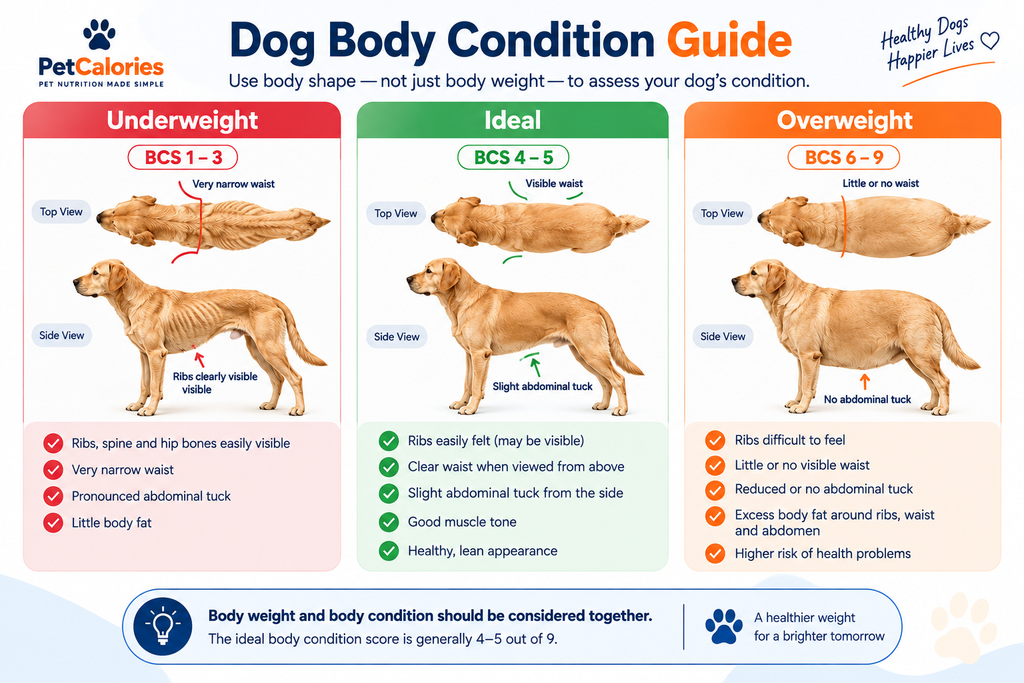
Your dog’s body shape can tell you a lot about whether they are getting the right amount of food. The number on the scale is useful, but it doesn’t tell the whole story.
Ideally, you should be able to feel your dog’s ribs without a thick layer of fat and see a clear waist when looking from above. From the side, the belly should tuck up slightly toward the back legs.
The WSAVA Body Condition Score uses a 1–9 scale, with 4–5 generally considered ideal.
If your dog is gradually gaining body fat, they may be eating more calories than they need even if the amount of food looks reasonable.
Size and Individual Differences
Your dog’s size and breed can affect how many calories they need, but there is no single calorie amount that works for every dog.
For example, two dogs that both weigh 20 kg may need different amounts of food. One might be very active, while the other spends most of the day resting.
That’s why a dog calorie calculator is best used as a starting point, not an exact number for every dog.
How Many Calories Should a Puppy Eat?
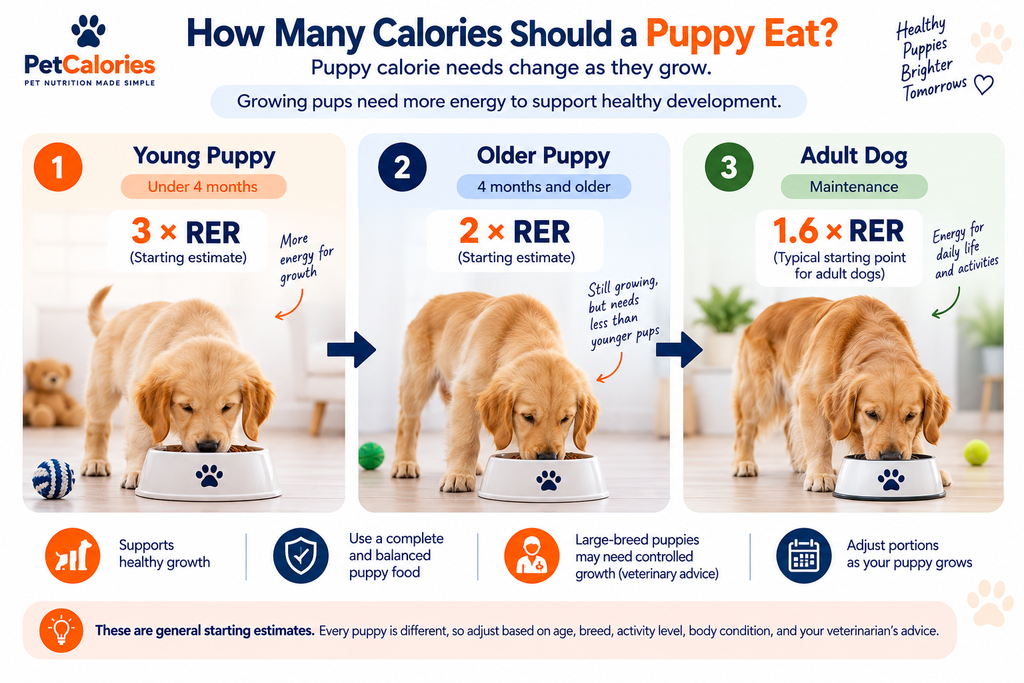
Puppies need more calories because they are growing and developing. Their calorie needs also change as they get older.
For healthy puppies, a common starting estimate is 3 × RER for puppies under four months and 2 × RER for puppies over four months. These are starting estimates, not exact numbers for every puppy.
But calories aren’t the only thing that matters. Puppies need a complete and balanced diet made for growth, and large-breed puppies have some additional nutritional needs.
Because puppies grow quickly, their food and calorie needs can change over time.
You can use our Puppy Growth Feeding Calculator to get a starting estimate based on your puppy’s age and weight.
What About Dogs That Need to Lose Weight?
If your dog is carrying extra weight, simply giving them much less food isn’t always the best answer. They still need enough calories and nutrients to stay healthy while losing weight.
Start by looking at your dog’s body condition and ideal weight. If your dog is significantly overweight or has another health condition, your veterinarian can help you choose a safe feeding plan.
And don’t forget about treats.
Biscuits, table scraps, dental treats, and little rewards during training can add more calories than you might expect.
WSAVA guidance recommends that treats make up no more than about 10% of a dog’s daily calorie intake. The rest should come from a complete and balanced diet.
For example, if your dog has a daily allowance of 600 calories, around 60 calories could come from treats.
If you’re working on your dog’s weight, you can also use our Dog Weight Loss Calculator.
How Do I Turn Calories Into Cups of Dog Food?
Knowing how many calories your dog needs is helpful, but you also need to know how many calories are in their food.
Check the food label for the calorie information. It may be listed as kcal per cup, can, pouch, or kilogram.
For example, if your dog needs 600 calories a day and their food contains 400 calories per cup:
600 ÷ 400 = 1.5 cups per day
Should I Follow the Feeding Chart on the Dog Food Bag?
If you feed your dog twice a day, that’s about ¾ cup per meal.
Keep in mind that different dog foods can have very different calorie amounts, even when the serving size looks similar. Measuring your dog’s food consistently can also help, and a kitchen scale is often more accurate than guessing by eye.
Yes, you can use the feeding chart as a starting point, but it may not be the perfect amount for your dog.
Every dog is different. If your dog is maintaining a healthy weight and body condition, the amount you’re feeding may be working well. If your dog is slowly gaining weight, you may need to adjust the amount. If they are losing weight without an obvious reason, it’s best to speak with your veterinarian.
Your dog’s needs can also change over time. For example, they may become less active during hot or rainy weather, recover from an injury, or start exercising more.
The goal isn’t to follow one number forever. It’s to find an amount that keeps your dog at a healthy weight and adjust it when their needs change.

How Can I Tell If My Dog Is Eating the Right Amount?
The best way to tell if you’re feeding your dog the right amount is to look at their weight and body shape, not just how much food goes into the bowl.
Keep an eye on:
- Body weight
- Whether you can easily feel their ribs
- A visible waist when viewed from above
- A slight tummy tuck when viewed from the side
- Activity level
- Appetite
- Changes in body fat or muscle
You don’t need to weigh your dog every day. What matters most is noticing gradual changes over time.
For example, if your dog is slowly gaining weight and their waist is becoming harder to see, they may be getting more calories than they need.
On the other hand, unexplained weight loss shouldn’t simply be treated by giving them more food. If you notice ongoing or unusual changes in your dog’s weight, it’s best to talk with your veterinarian.

When Should I Talk to a Veterinarian?
Your dog’s calorie needs can change with age, activity, body condition, diet, and health.
A veterinarian should be involved if your dog:
- Has unexplained weight loss
- Is gaining weight quickly
- Has a significant change in appetite
- Is severely overweight or underweight
- Has a medical condition
- Is pregnant or nursing
- Has growth concerns
- Has other unusual changes in eating, activity, or body condition
A calorie calculator can provide a useful estimate, but it cannot diagnose a health problem or replace individualized veterinary advice.
If your dog is losing weight without an obvious reason, don’t simply increase their food based on a calculator. The cause of the weight change matters.
Frequently Asked Questions
How Many Calories Should My Dog Eat?
There is no single calorie target for every dog. Your dog’s daily calorie needs depend on weight, age, activity level, body condition, neuter status, and overall health.
How many calories should a 10 kg dog eat?
A 10 kg dog has an RER of about 394 calories per day. For a healthy neutered adult, a starting maintenance estimate using 1.6 × RER would be about 630 calories per day. The actual amount can be higher or lower depending on the dog.
Can a dog eat too few calories?
Yes. Feeding too little for too long can leave a dog without enough energy and nutrients. If your dog needs to lose weight, it’s better to use a proper plan rather than simply cutting their food drastically.
Do treats count toward daily calories?
Yes. Treats, table scraps, chews, and training rewards all count. A common guideline is to keep treats to about 10% or less of your dog’s daily calories.
Should puppies eat the same number of calories as adult dogs?
No. Puppies are growing, so they usually need more energy for their size. Their needs also change as they grow, so their feeding amount should be reviewed regularly.
Can I use a dog calorie calculator instead of seeing a veterinarian?
A calorie calculator can give you a useful starting estimate, but it cannot replace veterinary advice. If your dog has a medical condition, significant obesity, unexplained weight changes, or special nutritional needs, speak with your veterinarian.
The Bottom Line
There isn’t one perfect calorie number that works for every dog.
So, how many calories should my dog eat? A calorie calculation can give you a useful starting point, but your dog’s body condition and weight over time help show whether that amount is right for them.
Your dog’s calorie needs depend on more than body weight. Age, activity level, body condition, neuter status, size, diet, and health can all affect how much energy your dog needs.
A calorie calculation can give you a useful starting point, but your dog’s weight and body condition over time help show whether that starting point is actually working.
Measure food consistently, remember that treats count, and reassess your dog’s needs when their lifestyle or health changes.
If you’re looking for a quick starting estimate, use the PetCalories Dog Calorie Calculator to estimate your dog’s daily calorie needs.