How Many Calories Should My Cat Eat? A Simple Guide for Cat Owners
If you’ve ever wondered, “how many calories should my cat eat?” you’re not alone. Many cat owners are unsure how much food their cat actually needs, especially when different factors such as weight, age, activity, and health can affect calorie needs.
The confusing part is that you can search online and find several different answers. One website might say your cat needs around 200 calories a day, while another gives you a different number. That does not necessarily mean one of them is wrong. A cat’s calorie needs depend on much more than body weight alone.
A young, active cat may need more energy than a quiet indoor cat. A growing kitten has very different nutritional needs from an adult. A neutered cat may have different energy needs from an intact cat, and an older cat that is losing weight may need a different feeding plan.
Even two cats that weigh exactly the same can have different calorie requirements.
So rather than looking for one “perfect” number, it is better to calculate a sensible starting estimate and then pay attention to your cat’s weight, body condition, appetite, activity, and overall health.
This guide explains how many calories your cat may need each day, how to calculate a starting estimate, how to turn calories into actual food portions, and when a veterinarian should be involved.
How Many Calories Should My Cat Eat Per Day?
There isn’t one calorie number that is right for every cat. Your cat’s calorie needs can change depending on their weight, age, activity level, body condition, and overall health.
Veterinarians often start with a calculation called Resting Energy Requirement (RER). In simple terms, RER is an estimate of how many calories a healthy cat needs while resting.
Calculate your cat’s RER
For an adult cat weighing more than 2 kg and less than 45 kg, you can use this simple formula:
RER = (30 × your cat’s weight in kg) + 70
For example, if your cat weighs 4 kg:
30 × 4 = 120
120 + 70 = 190
So the estimated RER is approximately 190 calories per day.
This is only a starting estimate, not a fixed daily feeding amount. Merck Veterinary Manual notes that calorie needs can vary between individual cats.
For example, Merck uses different starting factors depending on the cat, including 1.4 × RER for intact adults, 1.2 × RER for neutered adults, and 1.0 × RER for obesity-prone cats.
For an overweight cat, the appropriate calorie target should also consider their ideal weight and body condition.
Important: These calculations help you understand calorie needs, but an overweight cat’s weight-loss plan should be individualized and monitored.
If you’re not sure how to calculate your cat’s daily calorie needs, the PetCalories Cat Calorie Calculator can make the process much easier. You can enter details about your cat, such as body weight, life stage, activity level, body condition, and feeding or weight-management goal, to get a personalized starting estimate based on the information you provide.
How Do I Calculate My Cat’s Daily Calorie Needs?
Let’s work through a simple example.
Imagine you have a healthy adult cat weighing 4 kg.
Using the RER formula:
RER = 70 × (4^0.75)
That gives approximately:
198 kcal/day
Now suppose this is a healthy neutered adult cat. Using the starting factor of 1.2:
198 × 1.2 = 238 kcal/day
So approximately 238 calories per day would be a reasonable starting estimate for this example.

If your cat maintains a healthy body condition at a somewhat different calorie intake, that does not automatically mean the calculation was wrong. These formulas are estimates, and your cat’s response matters.
For a quicker starting estimate, you can also use the PetCalories Cat Calorie Calculator.
What Changes a Cat’s Calorie Needs?
This is where calorie requirements become more personal.
Age and Life Stage
A kitten is not simply a smaller adult cat.
Growing kittens need considerably more energy because they are developing bones, muscles, organs, and other tissues. Veterinary guidance recognizes that kittens have particularly high energy requirements during growth.
Adult cats generally need enough energy to maintain a healthy body weight and body condition.
As cats get older, the picture can change again. Some senior cats become less active and gain weight, while others lose weight or muscle and may need more nutritional attention. AAHA/AAFP guidance recommends monitoring weight and body condition throughout the mature and senior life stages rather than assuming every older cat needs the same feeding plan.
Activity Level
Think about what your cat actually does during a normal day.
Does your cat spend most of the day sleeping? Do they regularly chase toys, climb, run around the house, or explore?
Activity affects energy expenditure, so two cats of the same weight may not need identical calorie intakes.
This is also why simply searching for “calories for a 10-pound cat” can give you only a rough starting point.
Spay or Neuter Status
Neutering is another factor worth considering.
AAHA/AAFP guidance identifies neutering as a risk factor for weight gain and recommends paying attention to calorie intake and body condition.
This does not mean every neutered cat needs exactly the same calorie reduction. It means reproductive status is one of the factors that belongs in the overall picture.
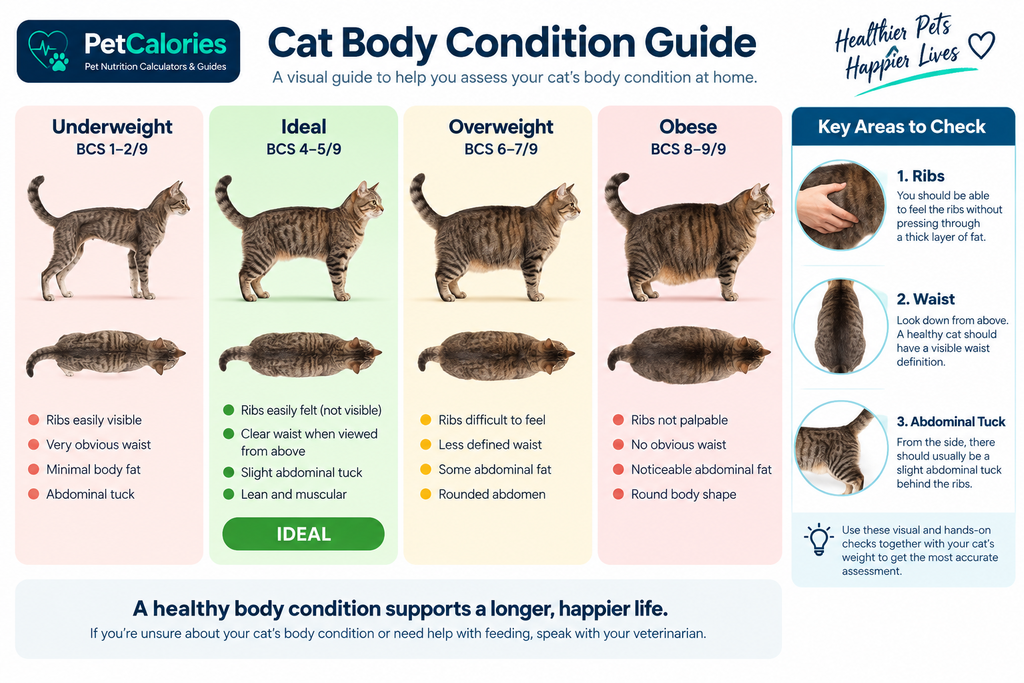
Body Condition
Your cat’s shape may tell you more than the number on the scale.
You should generally be able to feel the ribs without pressing through a thick layer of fat. When viewed from above, a healthy cat should have some waist definition. From the side, there should usually be some abdominal tuck.
Body Condition Score, or BCS, is commonly used alongside body weight to assess whether a cat is underweight, ideal, overweight, or obese. Veterinary guidelines emphasize feeding to an appropriate body and muscle condition rather than relying on weight alone.
How Many Calories Should a Kitten Eat?
Kittens need substantially more energy than adult cats because they are growing rapidly.
Merck lists 2.5 × RER as a general starting factor for healthy kittens.
For example, imagine a kitten weighing 2 kg.
Its RER would be approximately:
70 × (2^0.75) ≈ 118 kcal/day
Using the kitten factor:
118 × 2.5 ≈ 295 kcal/day
That gives us a starting estimate of roughly 295 calories per day.

However, kitten nutrition should not be reduced to a single formula.
Their needs change as they grow. AAHA notes that energy requirements can be particularly high early in kittenhood and recommends appropriate nutrition and monitoring during growth.
Kittens should receive a complete and balanced diet formulated for growth, rather than simply eating a smaller portion of adult food.
So if you have a growing kitten, don’t assume the same calorie target will remain appropriate for months.
If you’re not sure how to work out your kitten’s daily calorie needs, you can use the PetCalories Kitten Growth Feeding Calculator. Simply enter your kitten’s details to get a practical starting estimate based on their current weight and growth stage.
How Many Calories Does an Indoor Cat Need?
This is one of the most common questions, and the answer is not simply “a certain number because the cat is indoors.”
An indoor cat may be very active or extremely sedentary.
One indoor cat might spend hours climbing, chasing toys, and exploring the house. Another might sleep most of the day and move very little.
Instead of using “indoor” as the only factor, consider:
- Current body weight
- Body condition
- Activity level
- Age
- Spay/neuter status
- Current food intake
- Overall health
If your indoor cat is slowly gaining body fat, that may be a sign that their current calorie intake is higher than their individual needs.
The goal is not to find a special “indoor cat number.” The goal is to find an amount of food that helps your individual cat maintain a healthy body condition.
How Do I Turn Calories Into Cups or Cans of Cat Food?
Once you know your cat’s estimated daily calorie target, you can use the calorie information on the food label to work out the right portion. Look for the food’s kcal per cup or kcal per can. For example, if your cat’s daily target is 240 calories and the dry food provides 400 calories per cup, divide 240 by 400 to get 0.6 cup of food per day. If you feed your cat twice a day, divide 0.6 by 2, which gives about 0.3 cup per meal.
Remember: This is only a portion-calculation example. Your cat’s actual daily calorie target should be based on their individual needs.

This is a much better way to work out portions than simply copying the amount another cat eats.
The same principle applies to wet food.
For example, if a can contains 180 calories and your cat’s daily target is 240 calories, you can calculate the portion based on calories rather than guessing from the size of the can.
And remember: when you change foods, the portion may need to change too. Two foods can have very different calorie densities even when the serving sizes look similar.
Wet Food vs. Dry Food: Which Has More Calories?
There is no simple rule that says wet food is always lower in calories or dry food is always higher.
The major difference is that wet food contains much more water.
Dry food contains relatively little water, so a smaller physical amount can provide a substantial number of calories. Wet food contains more water, so a larger physical portion may provide a similar number of calories.
That’s why comparing ½ cup of one food with ½ cup of another can be misleading.
Instead, check the calorie information for the particular product you are feeding.
For dry food, this may be listed as calories per cup. For wet food, it may be listed per can, pouch, or other serving.
If you are combining wet and dry food, add the calories from both rather than treating one as separate from the day’s total.
Do Cat Treats Count Toward Daily Calories?
Yes — and they are easy to overlook.
A single small treat may not seem important. But if your cat receives several treats during the day, plus food toppers, table scraps, or other extras, those calories can add up.
WSAVA recommends keeping treats to no more than 10% of a cat’s daily calorie intake.
For example, if your cat’s daily calorie target is 240 calories:
240 × 10% = 24 calories
So around 24 calories would represent 10% of that daily total.
That does not mean your cat has to receive exactly 24 calories from treats. It simply shows why treats should be counted as part of the day’s total intake.
If your cat is overweight, treats may need to be limited further as part of the overall feeding plan.
You can read the WSAVA guidance on feeding treats to cats for additional information.
How Many Calories Should an Overweight Cat Eat?
This is one area where you should not rely on a generic internet number.
If your cat is overweight, it can be tempting to cut their normal food dramatically. But simply feeding much less of a regular maintenance diet can create nutritional problems because the cat may receive fewer essential nutrients along with the reduced calories.
AAHA guidance notes that weight-loss diets can be formulated to provide adequate nutrients while reducing calorie intake.
Weight loss should also be gradual.
Cats should not lose weight too quickly because rapid weight loss can be dangerous and can contribute to hepatic lipidosis, also known as fatty liver disease. AAHA recommends veterinary involvement and gradual weight loss rather than aggressive food restriction.
If your cat needs to lose weight, the safest approach is to determine an appropriate target with your veterinarian, measure food consistently, and monitor progress rather than simply cutting portions as much as possible.
What About Senior Cats?
Senior cats don’t all need fewer calories.
In fact, this is another area where a simple rule can be misleading.
Some older cats become less active and gain weight. Others lose weight or muscle as they age and may need more nutritional attention.
AAHA notes that mature and senior cats can have changing dietary needs, and monitoring weight and body condition is important during these life stages.
That’s why an unexplained change in weight in an older cat deserves attention rather than automatically being blamed on aging.
Pay attention to changes in:
- Weight
- Appetite
- Muscle condition
- Activity
- Eating habits
- Drinking and urination
If an older cat is losing weight without an intentional change in their feeding plan, speak with a veterinarian.
How Can I Tell If My Cat Is Eating the Right Amount?
You don’t need to weigh every meal forever to know whether your feeding plan is working, but measuring portions carefully at the beginning can make a big difference.
Then watch the trend.
A cat that maintains a stable, healthy body condition is giving you useful feedback that the current feeding plan may be appropriate.
On the other hand, gradual weight gain, increasing body fat, or loss of muscle may mean the feeding plan needs to be reviewed.
Pay attention to:
- Body weight
- Body condition
- Muscle condition
- Appetite
- Activity level
- Changes in eating habits
AAHA/AAFP guidance recommends considering these individual factors when developing a nutritional plan rather than relying on weight alone.
This is why checking your cat regularly can be more useful than becoming overly focused on one calorie number.
When Should I Talk to a Veterinarian?
A calorie calculator can help you estimate your cat’s energy needs, but it cannot tell you why a cat is gaining or losing weight.
Talk with a veterinarian if your cat:
- Loses weight without an obvious reason
- Gains weight rapidly
- Suddenly eats much more or much less
- Stops eating
- Becomes unusually tired
- Loses noticeable muscle
- Drinks or urinates much more than usual
- Has repeated vomiting or diarrhea
- Is pregnant or nursing
- Is a kitten with feeding or growth concerns
- Has a medical condition that affects diet or weight
This is particularly important if a cat stops eating.
A reduced appetite can have many possible causes, so it should not automatically be treated as a simple calorie or weight-management problem.
Your veterinarian can evaluate your cat’s weight, body condition, muscle condition, diet, lifestyle, and health together.
Frequently Asked Questions
How many calories should my cat eat per day?
There is no single number for every cat. A starting estimate depends on body weight, age, activity, body condition, spay/neuter status, and health.
For example, veterinary calculations may use RER followed by an appropriate needs factor. The resulting number should be treated as a starting point and adjusted based on how your cat responds.
How many calories does a 10-pound cat need?
A 10-pound cat weighs about 4.5 kg, but its calorie requirement still depends on the individual cat.
WSAVA’s guidance gives approximately 240–270 kcal/day for an average healthy 4.5 kg adult cat in ideal body condition, while also noting that individual cats may need more or less.
How many calories should an indoor cat eat?
Indoor cats do not all have the same calorie needs.
A sedentary indoor cat may need less energy than a very active indoor cat. Body condition, weight, age, activity, and spay/neuter status should all be considered rather than relying on an “indoor cat” number alone.
How many calories should a kitten eat?
Growing kittens need considerably more energy than adult cats.
A commonly used starting factor for healthy kittens is 2.5 × RER, although their needs change as they grow.
Kittens should also receive a complete and balanced diet appropriate for growth.
Do cat treats count as calories?
Yes.
Treats, toppers, table food, and other extras all contribute calories. WSAVA recommends keeping treats to no more than about 10% of total daily calories.
Is wet food better than dry food for calorie control?
Not automatically.
Wet and dry foods have different calorie densities, so the important thing is to compare the calories provided by the specific product rather than comparing portions by volume alone.
How can I calculate my cat’s calorie needs?
You can calculate RER from your cat’s body weight and then apply an appropriate needs factor based on the cat’s situation.
If you want a simpler starting point, use the PetCalories Cat Calorie Calculator.
The Bottom Line
There isn’t one perfect answer to “How many calories should my cat eat?”
A calorie estimate is useful, but it is only the beginning.
Start with your cat’s weight and life stage. Consider activity, body condition, and spay/neuter status. Check the actual calorie content of the food you are feeding, measure portions rather than guessing, and remember that treats count too.
Then watch what happens.
If your cat maintains a healthy body condition, the feeding plan may be working well. If their weight or body condition changes, the feeding plan may need to change too.
And if your cat is losing weight unexpectedly, gaining weight quickly, or showing a major change in appetite, don’t try to solve everything with a calorie calculator. That’s a situation where veterinary advice matters.
Want to estimate your cat’s daily calorie needs? Try the PetCalories Cat Calorie Calculator and use the result as a starting point for planning your cat’s food intake.
Important Note
This article is for general educational purposes and is not a substitute for veterinary advice. Individual calorie requirements vary, particularly in kittens, senior cats, overweight cats, pregnant or nursing cats, and cats with medical conditions.
If you are concerned about your cat’s weight, appetite, diet, or health, speak with a qualified veterinarian.